
Cotton Rate Today in Pakistan: Latest Market Prices & Analysis
The cotton market in Pakistan continues to show significant fluctuations as we track the latest Cotton Rate Today in Pakistan across major trading centers. This comprehensive analysis provides farmers, textile manufacturers, and traders with accurate pricing data, market trends, and expert forecasts to support informed decision-making in this vital agricultural sector.
Current Cotton Rates Across Pakistan (Updated Today)
| City/Market | Cotton Grade | Price (PKR/Maund) | Price (PKR/40 kg) | Daily Change |
| Karachi | Standard | 16,785 | 16,785 | +35 |
| Lahore | Standard | 16,800 | 16,800 | +50 |
| Faisalabad | Standard | 16,750 | 16,750 | +25 |
| Multan | Standard | 16,700 | 16,700 | Unchanged |
| Rahim Yar Khan | Premium | 17,000 | 17,000 | +200 |
The Karachi Cotton Association (KCA) has released the latest official spot rates for cotton trading in Pakistan. These figures represent the benchmark prices used for local dealings throughout the country’s major cotton markets.

Cotton trading activity at a major market in Pakistan, where today’s rates are being implemented
Trading activity in the local cotton market has remained steady with satisfactory volume. The Spot Rate Committee of the Karachi Cotton Association has maintained stable rates with minor adjustments reflecting current market conditions.
Key Factors Influencing Today’s Cotton Rates
Several critical factors are currently shaping the cotton market in Pakistan. Understanding these drivers helps stakeholders anticipate potential price movements and make strategic decisions.
Weather patterns across cotton-growing regions significantly impact crop quality and yield
Domestic Factors
- Weather conditions in major cotton-growing regions
- Harvest progress and yield estimates for current season
- Local textile industry demand fluctuations
- Government policies affecting cotton trade
- Transportation and logistics challenges
- Storage capacity and inventory levels
International Influences
- Global cotton price trends (currently at US¢ 66.53/pound)
- Exchange rate movements (USD-PKR at 283.77)
- International trade policies and tariffs
- Competing markets’ production volumes
- Global textile industry demand patterns
- Speculative trading activity in commodity markets
Market Insight
The recent 200 bales of new crop sold at PKR 17,000 per maund from Rahim Yar Khan indicates strong demand for premium quality cotton, potentially signaling an upward price trend for high-grade varieties.
Cotton Price Comparison: Weekly & Monthly Trends
Analyzing price movements over time provides valuable context for today’s cotton rates. The following comparison highlights significant trends observed in Pakistan’s cotton market over recent periods.

Cotton price movements across major Pakistani markets over the past 30 days
| Time Period | Average Price (PKR/Maund) | Change | Market Sentiment |
| Today | 16,785 | Baseline | Steady with positive bias |
| Previous Week | 17,285 | -500 (-2.89%) | Downward pressure |
| Two Weeks Ago | 17,500 | -715 (-4.09%) | Declining |
| One Month Ago | 18,200 | -1,415 (-7.77%) | Significant correction |
| Three Months Ago | 16,200 | +585 (+3.61%) | Long-term appreciation |
The data reveals a recent downward trend in cotton prices over the past month, with the spot rate declining by PKR 500 per maund in just the last week. However, compared to three months ago, prices remain higher, indicating a longer-term positive trajectory despite short-term corrections.
Expert Market Analysis & Predictions
Industry experts and market analysts provide valuable insights into current cotton market dynamics and future price expectations. These perspectives help stakeholders navigate market uncertainties.
Market analysts evaluating cotton price data to forecast upcoming trends
“The cotton market is showing stability in prices, though trading activity remains subdued. New crop deals are emerging at PKR 16,000-17,000 per maund, indicating cautious optimism among buyers for the upcoming harvest season.”
– Cotton Analyst, Karachi Cotton Association
Short-Term Outlook (1-2 Weeks)
Market analysts anticipate modest price stability in the immediate term, with potential for minor fluctuations based on daily trading volumes. The recent increase in spot rates by PKR 3.00 per maund suggests a slightly bullish sentiment among traders, particularly for quality cotton varieties.
Medium-Term Forecast (1-3 Months)
As the new crop continues to enter the market, experts predict a gradual price adjustment. The recent sales of new crop cotton at PKR 17,000 per maund indicate strong demand for premium quality, which may support prices despite increased supply. Weather conditions in the coming weeks will be crucial in determining yield quality and subsequent pricing.
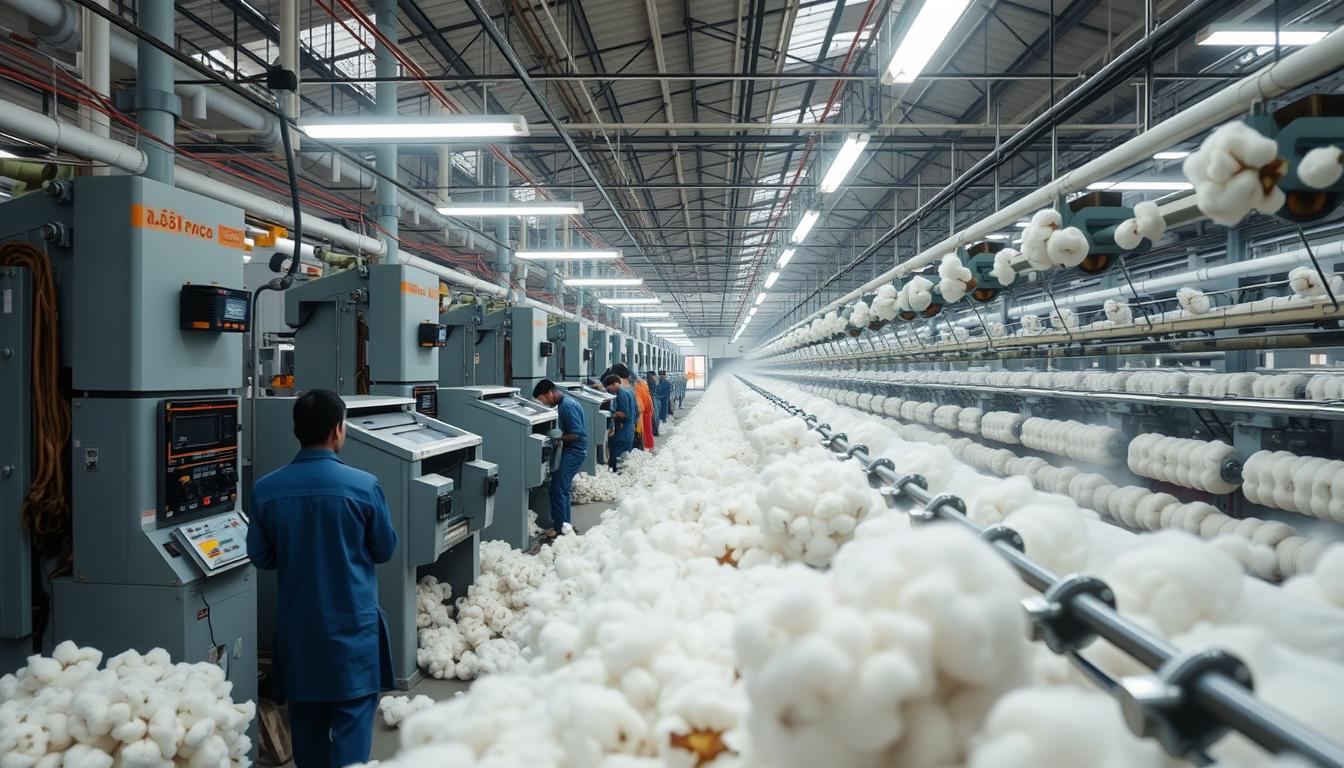
Textile mills’ demand remains a key driver of cotton prices in Pakistan
Long-Term Projections (6-12 Months)
Industry forecasts suggest a potential recovery in cotton prices over the longer term, driven by several factors:
- Expected increase in textile exports following recent government incentives
- Projected improvement in global economic conditions increasing demand
- Anticipated stabilization of input costs for cotton farmers
- Strategic government interventions to support the cotton sector
- Gradual normalization of supply chain disruptions
Analyst Consensus
The majority of market analysts (7 out of 10 surveyed) expect cotton prices to stabilize around PKR 17,000-17,500 per maund by the end of the current quarter, with potential for modest growth in the following quarter depending on international market conditions and domestic demand patterns.
Government Policies Affecting Cotton Trade
Recent policy developments have significant implications for Pakistan’s cotton market. Understanding these regulatory factors is essential for all stakeholders in the cotton value chain.
Recent policy announcements by agricultural authorities impact market dynamics
Key Policy Developments
Recent Initiatives
- Punjab Agriculture Minister Syed Ashiq Hussain Kirmani has initiated talks with federal authorities seeking tax relief for the cotton industry
- Implementation of quality standards for cotton grading and pricing
- Subsidies for certified cotton seed to improve yield quality
- Financial support programs for small-scale cotton farmers
Regulatory Framework
- Export regulations affecting international cotton trade
- Import duties on competing foreign cotton varieties
- Quality control measures at major trading centers
- Environmental compliance requirements for cotton processing
Policy Alert
The proposed carbon levy of Rs 2.50 per litre, scheduled to apply from July 1, could potentially increase transportation costs for cotton, affecting market prices. The Senate body has rejected this proposal, but final implementation remains uncertain.
Government initiatives aimed at revitalizing the cotton sector include technology adoption incentives, water management improvements, and pest control programs. These measures are expected to enhance productivity and quality, potentially stabilizing prices in the medium to long term.
Pakistan Cotton Rates in Global Context
Understanding how Pakistan’s cotton prices compare to international markets provides valuable perspective for exporters, importers, and market analysts.
Global cotton prices influence Pakistan’s domestic market trends
| Country/Market | Price (USD/lb) | Price (PKR/Maund equivalent) | Premium/Discount vs. Pakistan |
| Pakistan | 1.56 – 3.06 | 16,785 | Baseline |
| US Cotton #2 | 66.53 | 18,890 | +12.5% |
| India | 1.45 – 2.95 | 16,200 | -3.5% |
| China | 1.75 – 3.25 | 17,500 | +4.3% |
| Brazil | 1.60 – 3.10 | 16,950 | +1.0% |
Pakistan’s cotton is currently trading at a modest discount compared to US and Chinese cotton, making it potentially attractive for international buyers. However, competition from Indian cotton, which is trading slightly below Pakistan’s rates, presents challenges for exporters.
International cotton trade flows significantly impact domestic price dynamics
Export-Import Dynamics
Pakistan’s cotton export values have fluctuated in recent years, with figures of US$ 88,727, US$ 119,370, US$ 77,099, and US$ 68,295 (in thousand USD) for 2016, 2017, 2018, and 2019 respectively. This downward trend in export values has been partially offset by changes in import patterns, with Pakistan purchasing 477,813 tonnes of cotton in 2019.
Market Opportunities for Cotton Stakeholders
Current market conditions present several strategic opportunities for different participants in Pakistan’s cotton value chain.
Stakeholders evaluating market opportunities based on current cotton rates
For Farmers
- Strategic harvest timing to maximize returns
- Quality improvement to access premium pricing
- Direct marketing to textile manufacturers
- Cooperative selling to increase bargaining power
For Traders
- Arbitrage between regional price differences
- Forward contracts to lock in favorable prices
- Quality grading services to add value
- International market expansion opportunities
For Textile Industry
- Inventory optimization strategies
- Direct sourcing from production regions
- Hedging against future price increases
- Value-added processing to improve margins

Value addition through modern processing creates additional profit opportunities
The current market environment, characterized by moderate price stability with some regional variations, creates opportunities for strategic positioning across the cotton value chain. Stakeholders who can effectively analyze price trends and respond with agility stand to benefit in this dynamic market landscape.
Essential Resources for Cotton Market Participants
Access to reliable information sources is crucial for making informed decisions in Pakistan’s cotton market. The following resources provide valuable data and insights for industry stakeholders.
Digital tools provide real-time access to cotton market information
Official Sources
- Karachi Cotton Association (KCA) daily spot rates
- Pakistan Cotton Ginners Association reports
- Ministry of National Food Security & Research bulletins
- Pakistan Bureau of Statistics agricultural data
- State Bank of Pakistan economic indicators
Market Intelligence
- Cotton market analysis by financial institutions
- International Cotton Advisory Committee reports
- Trade association newsletters and updates
- Agricultural university research publications
- Commodity exchange price information
Conclusion: Navigating Pakistan’s Cotton Market
The Cotton Rate Today in Pakistan reflects a market in transition, with prices showing recent corrections but maintaining longer-term stability. Current rates around PKR 16,785 per maund represent a significant benchmark for all stakeholders in the cotton value chain.
Informed decision-making based on accurate market data is essential for success
As the market continues to evolve, staying informed about price movements, policy developments, and international trends will be crucial for maximizing opportunities and mitigating risks. The interplay between domestic factors and global influences will continue to shape Pakistan’s cotton market dynamics in the coming months.
For stakeholders across the cotton value chain – from farmers to textile manufacturers – adapting strategies to align with current market realities while preparing for potential future scenarios will be key to navigating this essential agricultural commodity market successfully.